Bringing you the recent scientific advancements in the field of Herpetology.
Episodes
Wednesday Aug 25, 2021
Wednesday Aug 25, 2021
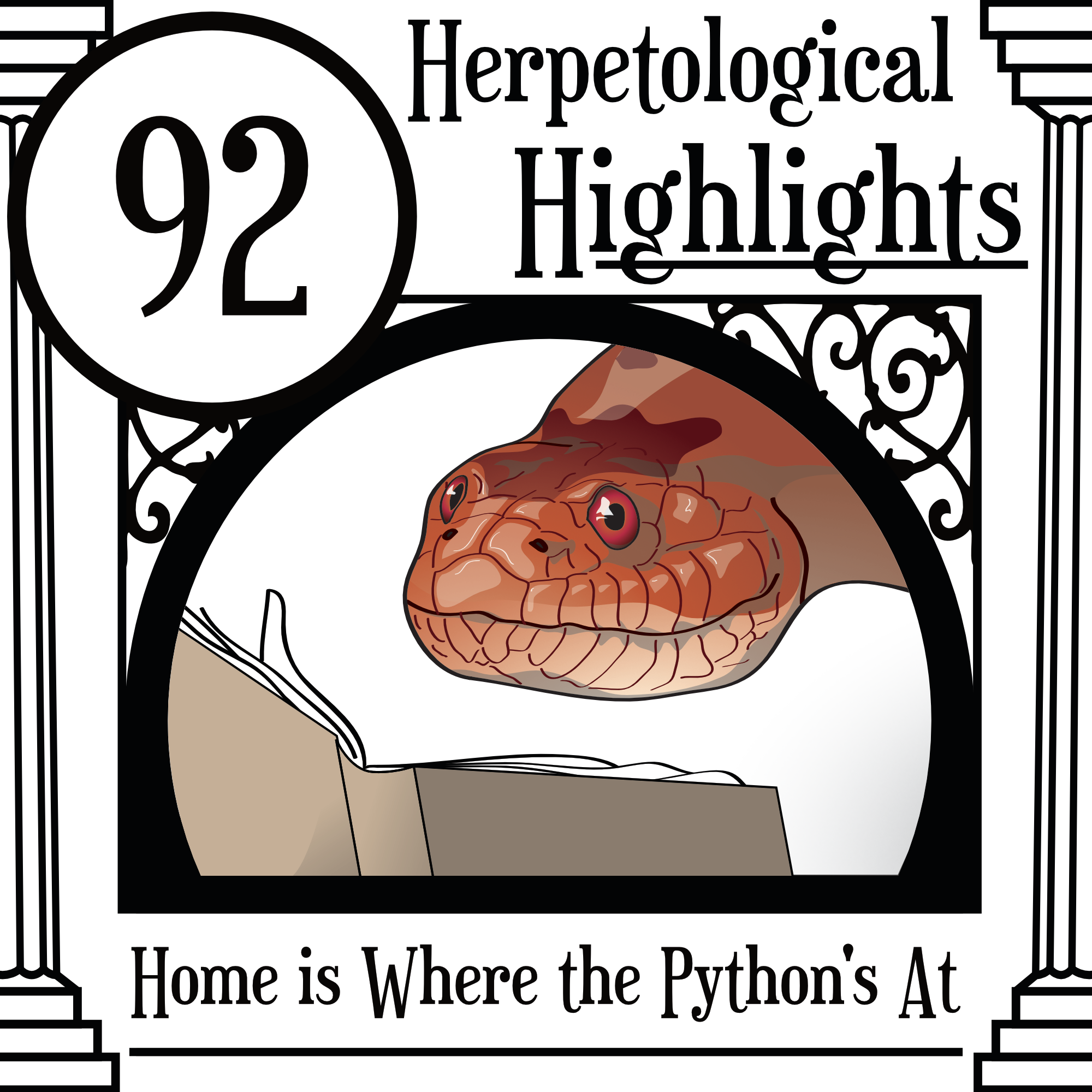
In this episode we are talking about the life and times of one of the world’s largest snakes - the Burmese python. We compare their movements in their native and introduced range, and talk a bit about what they get up to. Our Species of the Bi-Week is a colourful mimic.
Become a Patreon: https://www.patreon.com/herphighlights
FULL REFERENCE LIST AVAILABLE AT: herphighlights.podbean.com
Main Paper References:
Smith, S. N., Jones, M. D., Marshall, B. M., Waengsothorn, S., Gale, G. A., & Strine, C. T. (2021). Native Burmese pythons exhibit site fidelity and preference for aquatic habitats in an agricultural mosaic. Scientific Reports, 11(1), 1–13. https://doi.org/10.1038/s41598-021-86640-1
Bartoszek, I. A., Smith, B. J., Reed, R. N., & Hart, K. M. (2021). Spatial ecology of invasive Burmese pythons in southwestern Florida. Ecosphere, 12(6). https://doi.org/10.1002/ecs2.3564
Species of the Bi-Week:
Qi, S., Shi, J.-S., Ma, Y.-B., Gao, Y.-F., Bu, S.-H., Grismer, L. L., Li, P.-P., & Wang, Y.-Y. (2021). A sheep in wolf’s clothing: Elaphe xiphodonta sp. nov. (Squamata, Colubridae) and its possible mimicry to Protobothrops jerdonii. ZooKeys, 1048, 23–47. https://doi.org/10.3897/zookeys.1048.65650
Music:
Intro/outro – Treehouse by Ed Nelson
Species Bi-week theme – Mike Mooney
Other Music – The Passion HiFi, www.thepassionhifi.com
Thursday Jul 15, 2021
Thursday Jul 15, 2021
In the forests of the night, What immortal pit or eye, Could frame thy venomous symmetry? This episode we look at the biting behaviour, and glowing tails of vipers. Species of the Bi-week is a green treat from Southeast Asia.
Become a Patreon: https://www.patreon.com/herphighlights
FULL REFERENCE LIST AVAILABLE AT: herphighlights.podbean.com
Main Paper References:
Mendyk, R. W., & Laurence, P. (2021). Glow and Behold : Biofluorescence and New Insights on the Tails of Pitvipers (Viperidae: Crotalinae) and Other Snakes. Herpetological Review, 52(2), 221-237.
Piao, Y., Yao, G., Jiang, H., Huang, S., Huang, F., Tang, Y., Liu, Y., & Qin, C. (2021). Do pit vipers assess their venom? Defensive tactics of Deinagkistrodon acutus shift with changed venom reserve. Toxicon, 199, 101–108. https://doi.org/10.1016/j.toxicon.2021.06.003
Species of the Bi-Week:
Liu, S., Hou, M., Lwin, Y. H., Wang, Q., & Rao, D. (2021). A new species of Gonyosoma Wagler, 1828 (Serpentes, Colubridae), previously confused with G. prasinum (Blyth, 1854). Evolutionary Systematics, 5(1), 129–139. https://doi.org/10.3897/evolsyst.5.66574
Other Mentioned Papers/Studies:
Paul, L., & Mendyk, R. W. (2021). Glow and Behold: Biofluorescence and New Insights on the Tails of Pitvipers (Viperidae: Crotalinae) and Other Snakes. Herpetological Review, 52(2), 221-237.
Music:
Intro/outro – Treehouse by Ed Nelson
Species Bi-week theme – Mike Mooney
Other Music – The Passion HiFi, www.thepassionhifi.com
Saturday Jun 26, 2021
Saturday Jun 26, 2021
Urban snakes - are they more hip than their rural cousins, or do they suffer worse from parasites? We delve into some unexpected outcomes of urban life, followed by a brand new species of amphibian for our Species of the Bi-Week.
Become a Patreon: https://www.patreon.com/herphighlights
T-shirts and other swag: https://www.redbubble.com/people/herphighlights/shop
FULL REFERENCE LIST AVAILABLE AT: herphighlights.podbean.com
Main Paper References:
Lettoof, D., von Takach, B., Bateman, P. W., Gagnon, M. M., & Aubret, F. (2020). Investigating the role of urbanisation, wetlands and climatic conditions in nematode parasitism in a large Australian elapid snake. International Journal for Parasitology: Parasites and Wildlife, 11, 32–39. https://doi.org/10.1016/j.ijppaw.2019.11.006
Bury, S., & ZajĄc, B. (2020). The loss of sexual size dimorphism in urban populations of a widespread reptile, the European grass snake Natrix natrix. Current Zoology, 66(2), 217–218. https://doi.org/10.1093/cz/zoz034
Species of the Bi-Week:
Chávez, G., García-Ayachi, L. A., & Catenazzi, A. (2021). Beauty is in the eye of the beholder: Cruciform eye reveals new species of direct-developing frog (Strabomantidae, Pristimantis) in the Amazonian Andes. Evolutionary Systematics, 5, 81–92. https://doi.org/10.3897/evolsyst.5.63674
Other Mentioned Papers/Studies:
Sprent, J. F. A. (1988). Ascaridoid nematodes of amphibians and reptiles: Ophidascaris Baylis, 1920. Systematic Parasitology, 11(3), 165-213.
Music:
Intro/outro – Treehouse by Ed Nelson
Species Bi-week theme – Mike Mooney
Other Music – The Passion HiFi, www.thepassionhifi.com
Tuesday May 25, 2021
Tuesday May 25, 2021
Fluorescing frogs (toadlets) and glowing geckos are topics of discussion this episode. We dig into the whys and ecological context of glowing, but really there remains a lot to learn. Carrying over from last episode is a wonderful Bungarus for the Species of the Bi-week. Become a Patreon: https://www.patreon.com/herphighlights
FULL REFERENCE LIST AVAILABLE AT: herphighlights.podbean.com
Main Paper References:
Prötzel D, Heß M, Schwager M, Glaw F, Scherz MD. 2021. Neon-green fluorescence in the desert gecko Pachydactylus rangei caused by iridophores. Scientific Reports 11:297. DOI: 10.1038/s41598-020-79706-z.
Rebouças R, Carollo AB, Freitas M de O, Lambertini C. 2019. Is the conspicuous dorsal coloration of the Atlantic forest pumpkin toadlets aposematic? Salamandra 55:39–47.
Species of the Bi-Week:
Chen Z-N, Shi S-C, Vogel G, Ding L, Shi J-S. 2021. Multiple lines of evidence reveal a new species of Krait (Squamata, Elapidae, Bungarus) from Southwestern China and Northern Myanmar. ZooKeys 1025:35–71. DOI: 10.3897/zookeys.1025.62305.
Other Mentioned Papers/Studies:
Taboada, C., Brunetti, A.E., Pedron, F.N., Neto, F.C., Estrin, D.A., Bari, S.E., Chemes, L.B., Lopes, N.P., Lagorio, M.G. and Faivovich, J., (2017). Naturally occurring fluorescence in frogs. Proceedings of the National Academy of Sciences, 114(14), 3672-3677.
Other Links/Mentions:
Supplementary video for Prötzel et al., 2021: https://www.nature.com/articles/s41598-020-79706-z#Sec18
Mark Scherz blog about geckos: http://www.markscherz.com/archives/4715
Music:
Intro/outro – Treehouse by Ed Nelson
Species Bi-week theme – Mike Mooney
Other Music – The Passion HiFi, www.thepassionhifi.com
Friday May 14, 2021
Friday May 14, 2021
Kraits! These banded and venomous beasts are still shrouded in mystery, but we cover some of the things we DO know about them in this Patreon special.
Become a Patreon: https://www.patreon.com/herphighlights
FULL REFERENCE LIST AVAILABLE AT: herphighlights.podbean.com
Main Paper References:
Hodges, C. W., Barnes, C. H., Patungtaro, P., & Strine, C. T. (2021). Deadly dormmate: A case study on Bungarus candidus living among a student dormitory with implications for human safety. Ecological Solutions and Evidence, 2(e12047), 1–10. https://doi.org/10.1002/2688-8319.12047
Hodges, C. W., D’souza, A., & Jintapirom, S. (2020). Diurnal observation of a Malayan Krait Bungarus candidus (Reptilia: Elapidae) feeding inside a building in Thailand. Journal of Threatened Taxa, 12(8), 15947–15950. https://doi.org/10.11609/jott.5746.12.8.15947-15950
Crane, M., Oliver, K., Silva, I., Aksornneam, A., Artchawakom, T., Suwanwaree, P., & Strine, C. T. (2016). A report of a Malayan Krait snake Bungarus candidus mortality as by-catch in a local fish trap from Nakhon Ratchasima, Thailand. Tropical Conservation Science, 9(1), 313–320. https://doi.org/10.1177/194008291600900116
Knierim, T. K., Strine, C. T., Suwanwaree, P., & Hill, J. G. (2019). Spatial ecology study reveals nest attendance and habitat preference of banded kraits (Bungarus fasciatus). Herpetological Bulletin, 150, 6–13. https://doi.org/10.33256/hb150.613
Knierim, T. K., Marshall, B. M., Hayes, L., Waengsothorn, S., Suwanwaree, P., & Strine, C. T. (2018). The movements and habitat preferences of a Malayan krait (Bungarus candidus) in an agrarian landscape. Herpetological Bulletin, 143, 30–33.
Other Mentioned Papers/Studies:
Gaynor KM, Hojnowski CE, Carter NH, Brashares JS. 2018. The influence of human disturbance on wildlife nocturnality. Science 360:1232–1235. DOI: 10.1126/science.aar7121.
Karraker NE, Fischer S, Aowphol A, Sheridan J, Poo S. 2018. Signals of forest degradation in the demography of common Asian amphibians. PeerJ 6:e4220. DOI: 10.7717/peerj.4220.
Mohammadi S, Kluever BM, Tamashiro T, Amano Y, Hill Iii JG. 2014. Spatial and Thermal Observations of a Malayan Krait (Bungarus candidus) From Thailand. Tropical Natural History 14:21–26.
Tucker MA, et al. 2018. Moving in the Anthropocene: Global reductions in terrestrial mammalian movements. Science 359:466–469. DOI: 10.1126/science.aam9712.
Other Links/Mentions:
“Does ocean acidification alter fish behavior? Fraud allegations create a sea of doubt” By Martin Enserink - https://www.sciencemag.org/news/2021/05/does-ocean-acidification-alter-fish-behavior-fraud-allegations-create-sea-doubt
Music:
Intro/outro – Treehouse by Ed Nelson
Species Bi-week theme – Mike Mooney
Other Music – The Passion HiFi, www.thepassionhifi.com
Tuesday May 04, 2021
Tuesday May 04, 2021
Frogs: invasive menace, and victim. We look at two papers showing how frogs are faring in the face of human-caused species invasions. One where the frog is the invader, another where the frogs are facing down a novel threat –mongooses. Species of the Bi-week is a wee salamander from Japan.
Become a Patreon: https://www.patreon.com/herphighlights
FULL REFERENCE LIST AVAILABLE AT: herphighlights.podbean.com
Main Paper References:
Kim R, Halstead BJ, Routman EJ, Andersen J. 2021. When introduced prey violates trophic hierarchy: Conservation of an endangered predator. Biological Conservation 256:109019. DOI: 10.1016/j.biocon.2021.109019.
Komine H, Iwai N, Kaji K. 2021. Rapid responses in morphology and performance of native frogs induced by predation pressure from invasive mongooses. Biological Invasions 23:1293–1305. DOI: 10.1007/s10530-020-02440-0.
Species of the Bi-Week:
Okamiya H, Sugawara H, Nagano M, Poyarkov NA. 2018. An integrative taxonomic analysis reveals a new species of lotic Hynobius salamander from Japan. PeerJ 6:e5084. DOI: 10.7717/peerj.5084.
Other Mentioned Papers/Studies:
Cooper, W. (2005). The foraging mode controversy: Both continuous variation and clustering of foraging movements occur. Journal of Zoology, 267(2), 179-190. DOI: 10.1017/S0952836905007375
King, R.B., Ray, J.M., Stanford, K.M. (2006). Gorging on gobies: beneficial effects of alien prey on a threatened vertebrate. Canadian Journal of Zoology, 84, 108–115.
Other Links/Mentions:
RedBubble Storefront: https://www.redbubble.com/people/herphighlights/shop
Voices of Missouri's Toads and Frogs (1985) by Missouri Department of Conservation - https://www.youtube.com/watch?v=uDf_GLpC3uQ&feature=youtu.be&ab_channel=mooutdoors
Music:
Intro/outro – Treehouse by Ed Nelson
Species Bi-week theme – Mike Mooney
Other Music – The Passion HiFi, www.thepassionhifi.com
Tuesday Apr 06, 2021
Tuesday Apr 06, 2021
In this instalment we are talking tortoises - how clever are they, and how well do they get on with ravens? We follow up the tortoise double header with a miniature Species of the Bi-Week.
Become a Patreon: https://www.patreon.com/herphighlights
FULL REFERENCE LIST AVAILABLE AT: herphighlights.podbean.com
Main Paper References:
Santacà, M., Petrazzini, M. E. M., Agrillo, C., & Wilkinson, A. (2019). Can Reptiles Perceive Visual Illusions? Delboeuf Illusion in Red-Footed Tortoise (Chelonoidis carbonaria) and Bearded Dragon (Pogona vitticeps). Journal of Comparative Psychology, 133(4), 419–427. https://doi.org/10.1037/com0000176
Segura, A., Jimenez, J., & Acevedo, P. (2020). Predation of young tortoises by ravens: the effect of habitat structure on tortoise detectability and abundance. Scientific Reports, 10(1), 1–9. https://doi.org/10.1038/s41598-020-58851-5
Species of the Bi-Week:
Loc-Barragán, J. A., Reyes-Velasco, J., Woolrich-Piña, G. A., Grünwald, C. I., de Anaya, M. V., Rangel-Mendoza, J. A., & López-Luna, M. A. (2020). A new species of mud turtle of genus kinosternon (Testudines: Kinosternidae) from the pacific coastal plain of northwestern Mexico. Zootaxa, 4885(4), 509–529. https://doi.org/10.11646/zootaxa.4885.4.3
Other Mentioned Papers/Studies:
Smith, S. N., Jones, M. D., Marshall, B. M., Waengsothorn, S., Gale, G. A., & Strine, C. T. (2021). Native Burmese pythons exhibit site fidelity and preference for aquatic habitats in an agricultural mosaic. Scientific Reports, 11(1), 1-13.
Soldati, F., Burman, O. H. P., John, E. A., Pike, T. W., & Wilkinson, A. (2017). Long-term memory of relative reward values. Biology Letters, 13, 20160853. http://dx.doi.org/10.1098/rsbl.2016.0853
Music:
Intro/outro – Treehouse by Ed Nelson
Species Bi-week theme – Mike Mooney
Other Music – The Passion HiFi, www.thepassionhifi.com
Thursday Mar 18, 2021
Thursday Mar 18, 2021
Lizards live in a world of colour. But how do they react to different colours, and what role does colour play in creating new species of lizard? We dip into papers covering Anoles and Geckos, with a bend-toed Species of the Bi-week.
Become a Patreon: https://www.patreon.com/herphighlights
FULL REFERENCE LIST AVAILABLE AT: herphighlights.podbean.com
Main Paper References:
Fondren A, Swierk L, Putman BJ. 2020. Clothing color mediates lizard responses to humans in a tropical forest. Biotropica 52:172–181. DOI: 10.1111/btp.12744.
Fulgione D, Buglione M, Rippa D, Trapanese M, Petrelli S, Monti DM, Aria M, Del Giudice R, Maselli V. 2019. Selection for background matching drives sympatric speciation in Wall Gecko. Scientific Reports 9. DOI: 10.1038/s41598-018-37587-3.
Species of the Bi-Week:
Liu S, Rao D. 2021. A new species of Cyrtodactylus Gray, 1827 (Squamata, Gekkonidae) from Yunnan, China. ZooKeys 1021:109–126. DOI: 10.3897/zookeys.1021.60402.
Other Mentioned Papers/Studies:
Gould, M. L., Green, L., Altenau, B., & Blumstein, D. T. (2004). A study of the species-confidence hypothesis with Spiny-cheeked Honeyeaters (Acanthagenys rufogularis). Emu - Austral Ornithology, 104(3), 267– 271. https ://doi.org/10.1071/MU03033
Huang, B., Lubarsky, K., Teng, T., & Blumstein, D. T. (2011). Take only pictures, leave only fear? The effects of photography on the West Indian anole Anolis cristatellus. Current Zoology, 57(1), 77–82. https :// doi.org/10.1093/czool
Swierk, L. (2019). ANOLIS AQUATICUS (= NOROPS AQUATICUS) (Water Anole). UNDERWATER BREATHING. Herpetological Review, 50(1), 134–135.
Other Links/Mentions:
Dude! Nature podcast https://open.spotify.com/episode/2vlLbzAsEkQLv0YXkMxoB8?si=V1BBt-NfSDarUkAnSLrQaw
Pokemon beetles: https://www.enmu.edu/about/news-and-events/enmu-news/academic-news/3088-enmu-professor-s-beetle-discovery-named-after-three-legendary-bird-pokemon
Kestrel audio from Xeno-Canto recorded by: Peter Ward & Ken Hall [XC603740], Jerome Fischer [XC570888], Thomas G. Graves [XC565023]
Chickadee audio from Xeno-Canto recorded by: Thomas Magarian [XC464517]
Music:
Intro/outro – Treehouse by Ed Nelson
Species Bi-week theme – Mike Mooney
Other Music – The Passion HiFi, www.thepassionhifi.com
Battle music – “The Ritual/Ancient Battle” composed by Gerald Fried
Tuesday Mar 02, 2021
Tuesday Mar 02, 2021
This episode we delve into the problem solving capabilities of some large lizards, and uncover the lifestyle of Guatemalan beaded lizards. We also discuss the mysterious black beasts that inhabit the Caribbean Islands of the Lesser Antilles.
Become a Patreon: https://www.patreon.com/herphighlights
FULL REFERENCE LIST AVAILABLE AT: herphighlights.podbean.com
Main Paper References:
Ariano-Sánchez D, Mortensen RM, Reinhardt S, Rosell F. 2020. Escaping drought: Seasonality effects on home range, movement patterns and habitat selection of the Guatemalan Beaded Lizard. Global Ecology and Conservation 23:e01178. DOI: 10.1016/j.gecco.2020.e01178.
Cooper T, Liew A, Andrle G, Cafritz E, Dallas H, Niesen T, Slater E, Stockert J, Vold T, Young M, Mendelson J. 2019. Latency in Problem Solving as Evidence for Learning in Varanid and Helodermatid Lizards, with Comments on Foraging Techniques. Copeia 107:78. DOI: 10.1643/CH-18-119.
Species of the Bi-Week:
Other Mentioned Papers/Studies:
Crawford, L. E., Knouse, L. E., Kent, M., Vavra, D., Harding, O., LeServe, D., ... & Lambert, K. G. (2020). Enriched environment exposure accelerates rodent driving skills. Behavioural brain research, 378, 112309.
Other Links/Mentions:
Varanus prasinus opening a door: https://youtu.be/ukayoMTScXw
Heloderma charlesbogerti opening a door: https://youtu.be/JJZ6J1igNNo
Music:
Intro/outro – Treehouse by Ed Nelson
Species Bi-week theme – Mike Mooney
Other Music – The Passion HiFi, www.thepassionhifi.com
Tuesday Feb 16, 2021
Tuesday Feb 16, 2021
Humans and snakes share a long and storied past. In this episode we examine one paper that looks at the prehistoric relationship between humans and cobras (namely their spitting), and a second that looks at how we can mitigate the negative impacts of this relationship today. Our stunning Species of the Bi-week looks to be covered in duck-weed.
Become a Patreon: https://www.patreon.com/herphighlights
FULL REFERENCE LIST AVAILABLE AT: herphighlights.podbean.com
Main Paper References:
Kazandjian TD, Petras D, Robinson SD, van Thiel J, Greene HW, Arbuckle K, Barlow A, Carter DA, Wouters RM, Whiteley G, Wagstaff SC, Arias AS, Albulescu L-O, Plettenberg Laing A, Hall C, Heap A, Penrhyn-Lowe S, McCabe CV, Ainsworth S, da Silva RR, Dorrestein PC, Richardson MK, Gutiérrez JM, Calvete JJ, Harrison RA, Vetter I, Undheim EAB, Wüster W, Casewell NR. 2021. Convergent evolution of pain-inducing defensive venom components in spitting cobras. Science 371:386–390. DOI: 10.1126/science.abb9303.
Samuel SP, Chinnaraju S, Williams HF, Pichamuthu E, Subharao M, Vaiyapuri M, Arumugam S, Vaiyapuri R, Baksh MF, Patel K, Trim SA, Duncombe TE, Vaiyapuri S. 2020. Venomous snakebites: Rapid action saves lives—A multifaceted community education programme increases awareness about snakes and snakebites among the rural population of Tamil Nadu, India. PLOS Neglected Tropical Diseases 14:e0008911. DOI: 10.1371/journal.pntd.0008911.
Species of the Bi-Week:
Liu X, He Y, Wang Y, Beukema W, Hou S, Li Y, Che J, Yuan Z. 2021. A new frog species of the genus Odorrana (Anura: Ranidae) from Yunnan, China. Zootaxa 4908:263–275. DOI: 10.11646/zootaxa.4908.2.7.
Music:
Intro/outro – Treehouse by Ed Nelson
Species Bi-week theme – Mike Mooney
Other Music – The Passion HiFi, www.thepassionhifi.com