Bringing you the recent scientific advancements in the field of Herpetology.
Episodes
Tuesday Feb 06, 2018
Tuesday Feb 06, 2018
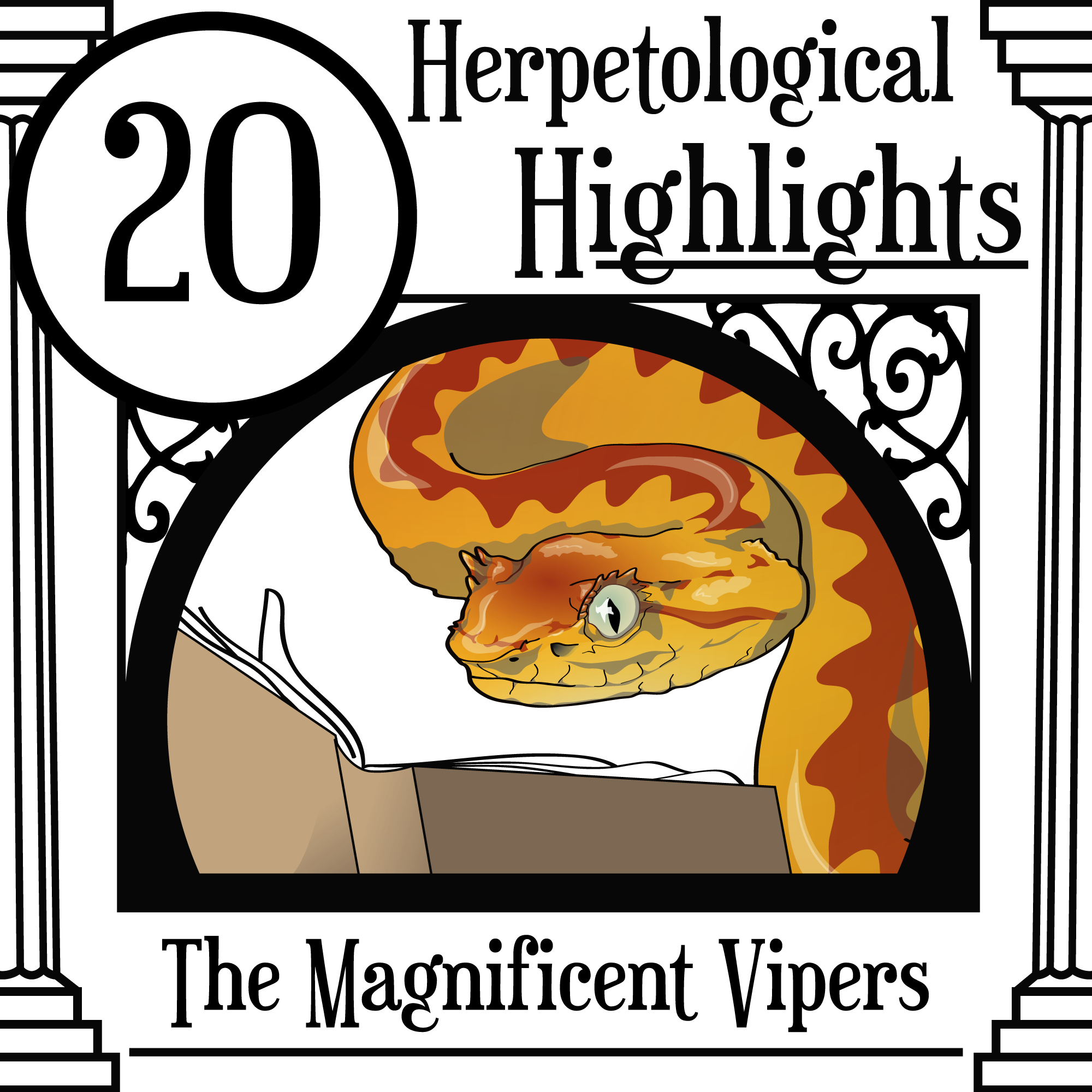
Vipers, vipers everywhere. In this episode we muddle our way through some venom research, and learn about the methods employed working out how widespread bushmasters are. Species of the bi-week is a frankly outstanding forest dweller from Costa Rica.
If you enjoy our podcast please vote for us for Reader's Radio Show of the Year on the Reptile Report! http://awards.thereptilereport.com/radio-show-of-the-year-2017/
FULL REFERENCE LIST AVAILABLE AT: herphighlights.podbean.com
Main Paper References:
González-Maya, José F., Fernando Castañeda, Rufino González, Jesús Pacheco, and Gerardo Ceballos. 2014. “Distribution, Range Extension, and Conservation of the Endemic Black-Headed Bushmaster (Lachesis melanocephala) in Costa Rica and Panama.” Herpetological Conservation and Biology 9 (2):369–77.
Roodt, Adolfo Rafael de, Leslie Victoria Boyer, Laura Cecilia Lanari, Lucia Irazu, Rodrigo Daniel Laskowicz, Paula Leticia Sabattini, and Carlos Fabián Damin. 2016. “Venom Yield and Its Relationship with Body Size and Fang Separation of Pit Vipers from Argentina.” Toxicon 121 (October):22–29.
Species of the Bi-Week:
Doan, Tiffany M., Andrew J. Mason, Todd A. Castoe, Mahmood Sasa, and Christopher L. Parkinson. 2016. “A Cryptic Palm-Pitviper Species (Squamata: Viperidae: Bothriechis) from the Costa Rican Highlands, with Notes on the Variation within B. Nigroviridis.” Zootaxa 4138 (2):271.
Other Mentioned Papers/Studies:
Dias, Lourdes, Mariana A.P. Rodrigues, André L. Rennó, Alessandra Stroka, Bruna R. Inoue, Patrícia C. Panunto, Anibal R. Melgarejo, and Stephen Hyslop. 2016. “Hemodynamic Responses to Lachesis Muta (South American Bushmaster) Snake Venom in Anesthetized Rats.” Toxicon 123 (December):1–14.
Fenwick, A. M., Gutberlet, R. L., Evans, J. A., & Parkinson, C. L. (2009). Morphological and molecular evidence for phylogeny and classification of South American pitvipers, genera Bothrops, Bothriopsis, and Bothrocophias (Serpentes: Viperidae). Zoological Journal of the Linnean Society, 156(3), 617-640.
Maritz, Bryan, Johannes Penner, Marcio Martins, Jelka Crnobrnja-Isailović, Stephen Spear, Laura R.V. Alencar, Jesús Sigala-Rodriguez, et al. 2016. “Identifying Global Priorities for the Conservation of Vipers.” Biological Conservation 204:94–102.
Quillfeldt, Petra, Jan O. Engler, Janet R.D. Silk, and Richard A. Phillips. 2017. “Influence of Device Accuracy and Choice of Algorithm for Species Distribution Modelling of Seabirds: A Case Study Using Black-Browed Albatrosses.” Journal of Avian Biology 48 (12):1549–55.
Rogalski, Aymeric, Christoffer Soerensen, Bianca op den Brouw, Callum Lister, Daniel Dashevsky, Kevin Arbuckle, Alexandra Gloria, et al. 2017. “Differential Procoagulant Effects of Saw-Scaled Viper (Serpentes: Viperidae: Echis ) Snake Venoms on Human Plasma and the Narrow Taxonomic Ranges of Antivenom Efficacies.” Toxicology Letters 280 (June):159–70.
Other Links/Mentions:
Birds deliberately spreading fire – Bonta, Mark, Robert Gosford, Dick Eussen, Nathan Ferguson, Erana Loveless, and Maxwell Witwer. 2017. “Intentional Fire-Spreading by ‘Firehawk’ Raptors in Northern Australia.” Journal of Ethnobiology 37 (4):700–718. https://doi.org/10.2993/0278-0771-37.4.700.
Orca talking, The Guardian – https://youtu.be/hqB1jRVw7Bw
Bushmaster video - https://www.youtube.com/watch?v=0hIERce2M30
King cobra vs reticulated python photo – https://www.facebook.com/TheReptileReport/posts/1469028556542349
Music:
Intro/outro – Treehouse by Ed Nelson
Other Music – The Passion HiFi, www.thepassionhifi.com
Tuesday Jan 23, 2018
Tuesday Jan 23, 2018
We usually think of invertebrates as a frog’s favourite meal. But in this episode we explore the times when the tables turn and frogs fall victim to mighty invertebrates. Except for the Accra snake-necked frog, they have an ingenious way of avoiding invertebrate conflict. Species of the Bi-week features a double-bill of tree frogs. FULL REFERENCE LIST AVAILABLE AT: herphighlights.podbean.com
Main Paper References:
Jablonski, Daniel. 2015. “Predation on Pristimantis ridens (Cope, 1866) by a Wandering Spider (Ctenidae Keyserling, 1877) in Mountain Cloud Forest of Costa Rica.” Herpetology Notes 8:1–3.
Luiz, Amom Mendes, Thiago Augusto Pires, Victor Dimitrov, and Ricardo Jannini Sawaya. 2013. “Predation on Tadpole of Itapotihyla langsdorffii (Anura: Hylidae) by the Semi-Aquatic Spider Thaumasia Sp. (Araneae: Pisauridae) in the Atlantic Forest, Southeastern Brazil.” Herpetology Notes 6 (1):451–52.
Rödel, Mark Oliver, Christian Brede, Mareike Hirschfeld, Thomas Schmitt, Philippe Favreau, Reto Stöcklin, Cora Wunder, and Dietrich Mebs. 2013. “Chemical Camouflage - A Frog’s Strategy to Co-Exist with Aggressive Ants.” PLoS ONE 8 (12).
Species of the Bi-Week:
Rivadeneira, C. Daniel, Pablo J. Venegas, and Santiago R. Ron. 2018. “Species Limits within the Widespread Amazonian Treefrog Dendropsophus Parviceps with Descriptions of Two New Species (Anura, Hylidae).” ZooKeys 726:25–77.
Other Mentioned Papers/Studies:
Menin, Marcelo, Domingos de Jesus Rodrigues, and Clarissa Salette de Azevedo. 2005. “Predation on Amphibians by Spiders (Arachnida, Araneae) in the Neotropical Region.” Phyllomedusa 4 (1):39–47.
Miranda, Everton B. P. de. 2017. “The Plight of Reptiles as Ecological Actors in the Tropics.” Frontiers in Ecology and Evolution 5:159.
Rödel MO, Braun U (1999) Associations between anurans and ants in a West African savanna (Anura: Microhylidae, Hyperoliidae, and Hymenoptera: Formicidae). Biotropica 31: 178–183.
Toledo, L. F. (2005). Predation of juvenile and adult anurans by invertebrates: current knowledge and perspectives. Herpetological Review, 36(4), 395-399.
Vrcibradic, Davor, Rogério L. Teixeira, and Vitor N.T. Borges-Júnior. 2009. “Sexual Dimorphism, Reproduction and Diet of the Casque-Headed Treefrog Itapotihyla Langsdorffii (Hylidae: Lophiohylini).” Journal of Natural History 43 (35–36):2245–56.
Ward-Fear, Georgia, Gregory P. Brown, Matthew J. Greenlees, and Richard Shine. 2009. “Maladaptive Traits in Invasive Species: In Australia, Cane Toads Are More Vulnerable to Predatory Ants than Are Native Frogs.” Functional Ecology 23 (3):559–68.
Ward-Fear, Georgia, Gregory P. Brown, and Richard Shine. 2010. “Factors Affecting the Vulnerability of Cane Toads (Bufo Marinus) to Predation by Ants.” Biological Journal of the Linnean Society 99 (4):738–51.
Other Links/Mentions:
Videos of Paltothyreus tarsatus ignoring Phrynomantis microps from Rödel et al. 2013 – http://journals.plos.org/plosone/article?id=10.1371/journal.pone.0081950
EDGE of Existence programme – https://www.edgeofexistence.org
Music – Treehouse by Ed Nelson
Tuesday Jan 09, 2018
Tuesday Jan 09, 2018
There is no denying that chameleons are fascinating lizards, but why should the tree-dwelling ones get all the credit? In this episode we unearth some recent discoveries concerning Brookesia and friends, as well as taking a look at the world's shortest lived tetrapod, Labord's chameleon. FULL REFERENCE LIST AVAILABLE AT: www.herphighlights.podbean.com
Main Paper References:
Miller, C. 2017. “Morphological and Roosting Variation in the Dwarf Chameleon Brookesia Stumpffi Between Primary, Secondary, and Degraded Habitats in Nosy Be, Madagascar.” Herpetological Conservation and Biology 12 (3): 599–605.
Eckhardt, F, PM Kappeler, and C Kraus. 2017. “Highly Variable Lifespan in an Annual Reptile, Labord’s Chameleon (Furcifer Labordi).” Scientific Reports 7 (1): 11397.
Species of the Bi-Week:
Branch, WR, J Bayliss, and KA Tolley. 2014. “Pygmy Chameleons of the Rhampholeon Platyceps Compex (Squamata: Chamaeleonidae): Description of Four New Species from Isolated ‘sky Islands’ of Northern Mozambique.” Zootaxa 3814 (1): 1–36.
Other Mentioned Papers/Studies:
Andrews, R. M., & Donoghue, S. (2004). Effects of temperature and moisture on embryonic diapause of the veiled chameleon (Chamaeleo calyptratus). Journal of Experimental Zoology Part A: Ecological Genetics and Physiology, 301(8), 629-635.
Aubret, F, R Shine, and X Bonnet. 2004. “Adaptive Developmental Plasticity in Snakes.” Nature 431 (7006): 261–62.
Glaw, F., Köhler, J., Townsend, T. M., & Vences, M. (2012). Rivaling the world's smallest reptiles: discovery of miniaturized and microendemic new species of leaf chameleons (Brookesia) from northern Madagascar. PLoS One, 7(2), e31314.
Karsten, K. B., Andriamandimbiarisoa, L. N., Fox, S. F., & Raxworthy, C. J. (2008). A unique life history among tetrapods: an annual chameleon living mostly as an egg. Proceedings of the National Academy of Sciences, 105(26), 8980-8984.
Losos, JB, KI Warheitt, and TW Schoener. 1997. “Adaptive Differentiation Following Experimental Island Colonization in Anolis Lizards.” Nature. 387.
Lucas, J, E Gora, and A Alonso. 2017. “A View of the Global Conservation Job Market and How to Succeed in It.” Conservation Biology 31 (6): 1223–31.
Raxworthy, CJ, MRJ Forstner, and RA Nussbaum. 2002. “Chameleon Radiation by Oceanic Dispersal.” Nature 415 (6873): 784–87.
Riedel, J., Boehme, W., Bleckmann, H., & Spinner, M. (2015). Microornamentation of leaf chameleons (Chamaeleonidae: Brookesia, Rhampholeon, and Rieppeleon)—with comments on the evolution of microstructures in the chamaeleonidae. Journal of morphology, 276(2), 167-184.
Tessa, G., Glaw, F., & Andreone, F. (2017). Longevity in Calumma parsonii, the World's largest chameleon. Experimental gerontology, 89, 41-44.
Music – Treehouse by Ed Nelson
Tuesday Dec 26, 2017
Tuesday Dec 26, 2017
This week’s episode is all about the bulkiest snake beast of them all – the ANACONDA. First we look into what neonate anacondas get up to. Then move onto a paper that investigates the human-anaconda conflict across South America (spoiler: people don’t like monster snakes). In lieu of a newly discovered anaconda we discuss a snake with a strange tail in Species of Bi-week. FULL REFERENCE LIST AVAILABLE AT: herphighlights.podbean.com
Main Paper References:
Rivas, Jesús A., Cesar R. Molina, Sarah J. Corey, and G. M. Burghardt. 2016. “Natural History of Neonatal Green Anacondas (Eunectes Murinus): A Chip Off the Old Block.” Copeia 104 (2): 402–10.
Miranda, Everton B P, Raimundo P Ribeiro-, and Christine Strüssmann. 2016. “The Ecology of Human-Anaconda Conflict: A Study Using Internet Videos.” Tropical Conservation Science 9 (1): 43–77.
Species of the Bi-Week:
Aengals, R., and S. R. Ganesh. 2013. "Rhinophis goweri-a new species of Shieldtail snake from the southern Eastern Ghats, India." Russian Journal of Herpetology 20 (1): 61-65.
Other Mentioned Papers/Studies:
De la Quintana, Paola, Jesús A. Rivas, Federico Valdivia, and Luis F. Pacheco. 2017. "Home range and habitat use of Beni anacondas (Eunectes beniensis) in Bolivia." Amphibia-Reptilia 38 (4): 547-553.
Denny, MW, BL Lockwood, and GN Somero. 2009. “Can the Giant Snake Predict Palaeoclimate?” Nature 460 (7255): E3–4.
Gans, Carl, Herbert C. Dessauer, and Dusan Baic. 1978. "Axial differences in the musculature of uropeltid snakes: the freight-train approach to burrowing." Science 199 (4325): 189-192.
Head, JJ, JI Bloch, AK Hastings, JR Bourque, EA Cadena, FA Herrera, PD Polly, and CA Jaramillo. 2009. “Head et Al. Reply.” Nature 460 (7255): E4–5.
Head, JJ, JI Bloch, AK Hastings, JR Bourque, EA Cadena, FA Herrera, PD Polly, and CA Jaramillo. 2009. “Giant Boid Snake from the Palaeocene Neotropics Reveals Hotter Past Equatorial Temperatures.” Nature 457 (7230). Nature Publishing Group: 715–17.
Headland, TN, and HW Greene. 2011. “Hunter-Gatherers and Other Primates as Prey, Predators, and Competitors of Snakes.” Proceedings of the National Academy of Sciences 108 (52): 1470–74.
Makarieva, AM, VG Gorshkov, and B-L Li. 2009. “Re-Calibrating the Snake Palaeothermometer.” Nature 460 (7255): E2–3.
Maritz, B, J Penner, M Martins, J Crnobrnja-Isailović, S Spear, LRV Alencar, J Sigala-Rodriguez, et al. 2016. “Identifying Global Priorities for the Conservation of Vipers.” Biological Conservation 204: 94–102.
Milanesi, P, FT Breiner, F Puopolo, and R Holderegger. 2017. “European Human-Dominated Landscapes Provide Ample Space for the Recolonization of Large Carnivore Populations under Future Land Change Scenarios.” Ecography 40: 1359–68.
Moleón, M, JA Sánchez-Zapata, JM Gil-Sánchez, JM Barea-Azcón, E Ballesteros-Duperón, and E Virgós. 2011. “Laying the Foundations for a Human-Predator Conflict Solution: Assessing the Impact of Bonelli’s Eagle on Rabbits and Partridges.” PLoS ONE 6 (7).
Natusch, D. J., and J. A. Lyons. 2012. "Relationships between ontogenetic changes in prey selection, head shape, sexual maturity, and colour in an Australasian python (Morelia viridis)." Biological Journal of the Linnean Society, 107 (2): 269-276.
O'Shea, Mark, Steve Slater, Rebecca Scott, Sarah A. Smith, Katie McDonald, Bob Lawrence and Marie Kubiak. 2016. “Eunectes murinus (Green Anaconda) Reproduction / Facultative parthenogenesis.” Herpetological Review 47 (1): 73
Pike, DA, L Pizzatto, BA Pike, and R Shine. 2008. “Estimating Survival Rates of Uncatchable Animals: The Myth of High Juvenile Mortality in Reptiles.” Ecology 89 (3): 607–11.
Potts, JM, ST Buckland, L Thomas, and A Savage. 2012. “Estimating Abundance of Cryptic but Trappable Animals Using Trapping Point Transects: A Case Study for Key Largo Woodrats.” Methods in Ecology and Evolution 3 (4): 695–703.
Sniderman, JMK. 2009. “Biased Reptilian Palaeothermometer?” Nature 460 (7255): E1–2.
Strimple, P. D. 1993. “Overview of the natural history of the green anaconda (Eunectes murinus).” Herpetological Natural History, 1(1): 25-35.
Waller T., Micucci P., Alvarenga E. 2007. Conservation biology of the yellow anaconda (Eunectes notaeus) in northeastern Argentina. In: Biology of the boas and pythons. Henderson R.W. and Powell R. (Eds). Eagle Mountain Publishing, Utah
Other Links/Mentions:
Uropeltidae blog - http://snakesarelong.blogspot.co.uk/2017/02/shield-tailed-snakes-uropeltidae.html
Harry Greene. Primates And Snakes, 75 Million Years Of Deadly Dialogue? - https://www.allaboutbirds.org/primates-and-snakes-75-million-years-of-deadly-dialogue-video/
Sami Asad’s. Frogs and deforestation, Science Slam Talk - https://youtu.be/7pvwtaZPicI
Music – Treehouse by Ed Nelson
Tuesday Dec 12, 2017
Tuesday Dec 12, 2017
Salamanders feature in episode 16, especially North American ones. We chat about the unusual inheritance strategies of Ambystoma, and territorial behaviour and polymorphism (multiple colour patterns) of red-backed salamanders. There will of course be a slippery surprise in our Species of the Bi-week. FULL REFERENCE LIST AVAILABLE AT herphighlights.podbean.com
Main Paper References:
Bogart, James P., Jessica E. Linton, and Al Sandilands. 2017. “A Population in Limbo: Unisexual Salamanders (Genus Ambystoma) Decline without Sperm-Donating Species.” Herpetological Conservation and Biology 12 (1): 41–55.
Reiter, M. K., Anthony, C. D., & Hickerson, C. A. M. (2014). Territorial behavior and ecological divergence in a polymorphic salamander. Copeia, 2014(3), 481-488.
Species of the Bi-week:
Mccranie, J. R., & Rovito, S. M. (2014). New species of salamander (Caudata: Plethodontidae: Cryptotriton) from Quebrada Cataguana, Francisco Morazán, Honduras, with comments on the taxonomic status of Cryptotriton wakei. Zootaxa, 3795(1), 61-70.
Other Mentioned Papers/Studies:
Bi, K, and JP Bogart. 2010. “Time and Time Again: Unisexual Salamanders (Genus Ambystoma) Are the Oldest Unisexual Vertebrates.” BMC Evolutionary Biology 10: 238. doi:10.1186/1471-2148-10-238.
Cleveland, WS, and R McGill. 1984. “Graphical Perceptions: Theory, Experimentation, and Application to the Development of Graphical Methods.” Journal of the American Statistical Association 79 (387): 531–54.
Petruzzi, EE, PH Niewiarowski, and FB-G Moore. 2006. “The Role of Thermal Niche Selection in Maintenance of a Colour Polymorphism in Redback Salamanders (Plethodon Cinereus).” Frontiers in Zoology 3: 10. doi:10.1186/1742-9994-3-10.
Verrell, P. A., & Krenz, J. D. (1998). Competition for mates in the mole salamander, Ambystoma talpoideum: tactics that may maximize male mating success. Behaviour, 135(2), 121-138.
Music: Treehouse by Ed Nelson
Tuesday Dec 05, 2017
Tuesday Dec 05, 2017
Tom caught up with renowned amphibian man and Imperial College master's student Steve Allain at Venom Day 2017 at Bangor University. Steve's midwife toad project features heavily, along with his upcoming master's research and general amphibian happenings.
Steve's twitter: https://twitter.com/stevoallain
Steve's blog: http://bioweb.ie/author/steven/
Tuesday Nov 28, 2017
Tuesday Nov 28, 2017
Snakes of the sea. Yellow, striped, you name it. We look into some factors changing their colours, and how has the yellow-bellied sea snake become so widespread? Another Species of the Bi-week that’s entirely yellow but not entirely a species. FULL REFERENCE LIST AVAILABLE AT: herphighlights.podbean.com
Main Paper References:
Brischoux, François, Cédric Cotté, Harvey B. Lillywhite, Frédéric Bailleul, Maxime Lalire, and Philippe Gaspar. 2016. “Oceanic Circulation Models Help to Predict Global Biogeography of Pelagic Yellow- Bellied Sea Snake.” Biology Letters 12: 6–9.
Goiran, Claire, Paco Bustamante, and Richard Shine. 2017. “Industrial Melanism in the Seasnake Emydocephalus Annulatus.” Current Biology. 1–4.
Species of the Bi-Week:
Bessesen, Brooke L., and Gary J. Galbreath. 2017. “A New Subspecies of Sea Snake, Hydrophis Platurus Xanthos, from Golfo Dulce, Costa Rica.” ZooKeys 686: 109–23.
Other Mentioned Papers/Studies:
Bonnet, Xavier, Marine J. Briand, François Brischoux, Yves Letourneur, Thomas Fauvel, and Paco Bustamante. 2014. “Anguilliform Fish Reveal Large Scale Contamination by Mine Trace Elements in the Coral Reefs of New Caledonia.” Science of the Total Environment 470–471. Elsevier B.V.: 876–82.
Chatelain, M., J. Gasparini, L. Jacquin, and A. Frantz. 2014. “The Adaptive Function of Melanin-Based Plumage Coloration to Trace Metals.” Biology Letters 10 (3): 20140164.
Cook, Timothée R., Xavier Bonnet, T. Fauvel, Richard Shine, and François Brischoux. 2016. "Foraging behaviour and energy budgets of sea snakes: insights from implanted data loggers." Journal of Zoology 298(2): 82-93.
Lillywhite, Harvey B., Coleman M. Sheehy Iii, François Brischoux, and Joseph B. Pfaller. 2015 "On the abundance of a pelagic sea snake." Journal of Herpetology 49(2): 184-189.
Pickwell, George V. 1971. "Knotting and coiling behavior in the pelagic sea snake Pelamis platurus (L.)." Copeia 1971(2): 348-350.
Reading, C. J., L. M. Luiselli, G. C. Akani, X. Bonnet, G. Amori, J. M. Ballouard, E. Filippi, G. Naulleau, D. Pearson, and L. Rugiero. 2010. “Are Snake Populations in Widespread Decline?” Biology Letters 6: 777–80.
Sanders, Kate L., Michael SY Lee, Terry Bertozzi, and Arne R. Rasmussen. 2013. "Multilocus phylogeny and recent rapid radiation of the viviparous sea snakes (Elapidae: Hydrophiinae)." Molecular phylogenetics and evolution 66(3): 575-591.
Shine, R., R. Reed, S. Shetty, and H. Cogger. 2002. "Relationships between sexual dimorphism and niche partitioning within a clade of sea-snakes (Laticaudinae)." Oecologia 133(1): 45-53.
Shine, Richard, Terri Shine, James M. Shine, and Benjamin G. Shine. 2005. “Synchrony in Capture Dates Suggests Cryptic Social Organization in Sea Snakes (Emydocephalus Annulatus, Hydrophiidae).” Austral Ecology 30 (7): 805–11.
Other Links/Mentions:
Yellow bellied sea snakes ‘knotting’ and feeding: https://www.youtube.com/watch?v=meGFcJ03bg0
iHerp Magazine Issue 3: https://view.joomag.com/iherp-australia-issue-3/0682664001501470952
Music – Treehouse by Ed Nelson
Sunday Nov 19, 2017
Sunday Nov 19, 2017
Crocodylians have been around for a while and they know what they’re doing. In this episode we discuss what they do when they’re ticked off, and how the massive, fascinating, and largely unknown Tomistoma is getting on in SE Asia. As always, we end on a new species, and this time it’s a fractious new species of something crocodile-like. FULL REFERENCE LIST AVAILABLE AT: herphighlights.podbean.com
Main Paper References:
Brien, Matthew L., Jeffrey W. Lang, Grahame J. Webb, Colin Stevenson, and Keith A. Christian. 2013. “The Good, the Bad, and the Ugly: Agonistic Behaviour in Juvenile Crocodilians.” PLoS ONE 8 (12).
Stuebing, R., R. Sommerlad, and A. Staniewicz. 2015. “Conservation of the Sunda Gharial Tomistoma Schlegelii in Lake Mesangat, Indonesia.” International Zoo Yearbook 49 (1): 137–49.
Species of the Bi-Week:
Foffa, Davide, Mark T. Young, Stephen L. Brusatte, Mark R. Graham, and Lorna Steel. 2017. “A New Metriorhynchid Crocodylomorph from the Oxford Clay Formation (Middle Jurassic) of England, with Implications for the Origin and Diversification of Geosaurini.” Journal of Systematic Palaeontology: 1–21.
Other Mentioned Papers/Studies:
Brochu, Christopher A. 2001. “Crocodylian Snouts in Space and Time: Phylogenetic Approaches Toward Adaptive Radiation.” American Zoologist 41 (November): 564–85.
Brown, Gregory, Richard Shine, Ruchira Somaweera, and Jonathan Webb. 2011. “Hatchling Australian Freshwater Crocodiles Rapidly Learn to Avoid Toxic Invasive Cane Toads.” Behaviour 148: 501–17.
Courchamp, Franck, and Corey J A Bradshaw. 2017. “100 Articles Every Ecologist Should Read.” Nature Ecology & Evolution.
Galdikas, B. M. 1985. "Crocodile predation on a proboscis monkey in Borneo." Primates, 26(4), 495-496.
Letnic, Mike, Jonathan K. Webb, and Richard Shine. 2008. “Invasive Cane Toads (Bufo Marinus) Cause Mass Mortality of Freshwater Crocodiles (Crocodylus Johnstoni) in Tropical Australia.” Biological Conservation 141 (7): 1773–82.
Milinkovitch, M. C., L. Manukyan, A. Debry, N. Di-Poi, S. Martin, D. Singh, D. Lambert, and M. Zwicker. 2013. “Crocodile Head Scales Are Not Developmental Units But Emerge from Physical Cracking.” Science 339 (6115): 78–81.
Smith, James G., and Ben L. Phillips. 2006. “Toxic Tucker: The Potential Impact of Cane Toads on Australian Reptiles.” Pacific Conservation Biology 12 (1): 40–49.
Yeager, C. P. 1991. "Possible antipredator behavior associated with river crossings by proboscis monkeys (Nasalis larvatus)." American Journal of Primatology, 24(1), 61-66.
Other Links/Mentions:
Tomistoma captive breeding success https://www.youtube.com/watch?v=SDkpwV2vRyM
Music – Treehouse by Ed Nelson
Tuesday Oct 31, 2017
Tuesday Oct 31, 2017
Everyone's favourite fungus is the topic of this week’s episode – Batrachochytrium dendrobatidis, otherwise known as Bd or Chytrid. We discuss some of the ways it spreads and a little about the frogs it affects. Species of the Bi-week is back and this time coming out of Amazonia. FULL REFERENCE LIST AVAILABLE AT: herphighlights.podbean.com
Main Paper References:
Kolby, Jonathan E., Sara D. Ramirez, Lee Berger, Kathryn L. Richards-Hrdlicka, Merlijn Jocque, and Lee F. Skerratt. 2015. “Terrestrial Dispersal and Potential Environmental Transmission of the Amphibian Chytrid Fungus (Batrachochytrium Dendrobatidis).” PLoS ONE 10 (4): 1–13.
Barrio-Amorós, César L., Christoph I. Grünwald, Héctor Franz-Chávez, Ángela María Mendoza, and Brandon Thomas La Forest. 2016. “Notes on Natural History and Call Description of the Critically Endangered Plectrohyla Avia (Anura: Hylidae) from Chiapas , Mexico.” Amphibian and Reptile Conservation 10 (2): 11–17.
Species of the Bi-Week:
Peloso, Pedro L.V., Victor G.D. Orrico, Célio F.B. Haddad, Geraldo R. Lima-Filho, and Marcelo J. Sturaro. 2016. “A New Species of Clown Tree Frog, Dendropsophus Leucophyllatus Species Group, from Amazonia (Anura, Hylidae).” South American Journal of Herpetology 11 (1): 66–80.
Other Mentioned Papers/Studies:
Arnold, S.J., 1976. "Sexual behavior, sexual interference and sexual defense in the salamanders Ambystoma maculatum, Ambystoma tigrinum and Plethodon jordani." Ethology, 42(3): 247-300.
Blooi, Mark, An Martel, Francis Vercammen, and Frank Pasmans. 2013. “Combining Ethidium Monoazide Treatment with Real-Time PCR Selectively Quantifies Viable Batrachochytrium Dendrobatidis Cells.” Fungal Biology 117 (2): 156–62.
Gower, D.J., Doherty-Bone, T., Loader, S.P., Wilkinson, M., Kouete, M.T., Tapley, B., Orton, F., Daniel, O.Z., Wynne, F., Flach, E. and Müller, H., 2013. "Batrachochytrium dendrobatidis infection and lethal chytridiomycosis in caecilian amphibians (Gymnophiona)." EcoHealth, 10(2):173-183.
Iwai, N., 2013. "Morphology, function and evolution of the pseudothumb in the Otton frog." Journal of Zoology, 289(2): 127-133.
Kolby, Jonathan E., Sara D. Ramirez, Lee Berger, Dale W. Griffin, Merlijn Jocque, and Lee F. Skerratt. 2015. “Presence of Amphibian Chytrid Fungus (Batrachochytrium Dendrobatidis) in Rainwater Suggests Aerial Dispersal Is Possible.” Aerobiologia 31 (3): 411–19. doi:10.1007/s10453-015-9374-6.
Liew, Nicole, Maria J. Mazon Moya, Claudia J. Wierzbicki, Michael Hollinshead, Michael J. Dillon, Christopher R. Thornton, Amy Ellison, Jo Cable, Matthew C. Fisher, and Serge Mostowy. 2017. “Chytrid Fungus Infection in Zebrafish Demonstrates That the Pathogen Can Parasitize Non-Amphibian Vertebrate Hosts.” Nature Communications 8 (April). Nature Publishing Group: 15048.
Lips, Karen R. 2016. “Overview of Chytrid Emergence and Impacts on Amphibians.” Philosophical Transactions of the Royal Society B: Biological Sciences 371 (1709): 20150465.
Longcore, J.E., Pessier, A.P. and Nichols, D.K., 1999. "Batrachochytrium dendrobatidis gen. et sp. nov., a chytrid pathogenic to amphibians." Mycologia: 219-227.
Olson, Deanna H., David M. Aanensen, Kathryn L. Ronnenberg, Christopher I. Powell, Susan F. Walker, Jon Bielby, Trenton W.J. Garner, George Weaver, and Matthew C. Fisher. 2013. “Mapping the Global Emergence of Batrachochytrium Dendrobatidis, the Amphibian Chytrid Fungus.” PLoS ONE 8 (2).
Van Rooij, Pascale, Frank Pasmans, Yanaika Coen, and An Martel. 2017. “Efficacy of Chemical Disinfectants for the Containment of the Salamander Chytrid Fungus Batrachochytrium Salamandrivorans.” PloS One 12 (10): e0186269.
Other Links/Mentions:
Video of Plectrohyla Avia from Barrio-Amorós et al. (2016) - https://www.youtube.com/watch?v=aa2O-BguqOY&feature=youtu.be
Salamander courtship with pheromone transmission - http://plethodon.science.oregonstate.edu/video/shermani%20slapping.avi
HARCC are mid fundraiser - go to frogrescue.com
Music – Treehouse by Ed Nelson
Tuesday Oct 17, 2017
Tuesday Oct 17, 2017
Following on from our interview with John McGrath, Australian geckos are our focus for episode 12. We talk about the influences on starred knob tail gecko habitat and why velvet geckos are important food for an elapid snake. Of course there is an Australian gecko for the Species of the Bi-Week. FULL REFERENCE LIST AVAILABLE AT: herphighlights.podbean.com
Main Paper References:
Driscoll, Don A., Catherine A. Whitehead, and Juliana Lazzari. 2012. “Spatial Dynamics of the Knob-Tailed Gecko Nephrurus Stellatus in a Fragmented Agricultural Landscape.” Landscape Ecology 27 (6): 829–41.
Webb, Jonathan K., David A. Pike, and Richard Shine. 2008. “Population Ecology of the Velvet Gecko, Oedura Lesueurii in South Eastern Australia: Implications for the Persistence of an Endangered Snake.” Austral Ecology 33 (7): 839–47.
Species of the Bi-Week:
Hoskin, Conrad J., and Patrick Couper. 2013. “A Spectacular New Leaf-Tailed Gecko (Carphodactylidae: Saltuarius) from the Melville Range, North-East Australia.” Zootaxa 3717 (4): 543–58.
Other Mentioned Papers/Studies:
Blay, Nicola, and Isabelle M Côté. 2001. “Optimal Conditions for Breeding of Captive Humboldt Penguins (Spheniscus Humboldti): A Survey of British Zoos.” Zoo Biology 20: 545–55.
Brown, G. P., and Shine, R. 2007. "Like mother, like daughter: inheritance of nest-site location in snakes." Biology letters, 3(2): 131-133.
Croak BM, Pike DA, Webb JK, Shine R, 2010. "Using artificial rocks to restore nonrenewable shelter sites in human-degraded systems: colonization by fauna." Rest Ecol 18:428–438.
Gamble, T. 2010. "A review of sex determining mechanisms in geckos (Gekkota: Squamata)". Sexual Development, 4(1-2): 88-103.
James, Alexander N., Kevin J. Gaston, and Andrew Balmford. 1999. “Balancing the Earth’s Accounts.” Nature 401 (6751): 323–24.
Llewelyn, John, Ben L. Phillips, Greg P. Brown, Lin Schwarzkopf, Ross A. Alford, and Richard Shine. 2011. “Adaptation or Preadaptation: Why Are Keelback Snakes (Tropidonophis Mairii) Less Vulnerable to Invasive Cane Toads (Bufo Marinus) than Are Other Australian Snakes?” Evolutionary Ecology 25 (1): 13–24.
Oliver, P. M., Bauer, A. M., Greenbaum, E., Jackman, T., and Hobbie, T. 2012. "Molecular phylogenetics of the arboreal Australian gecko genus Oedura Gray 1842 (Gekkota: Diplodactylidae): Another plesiomorphic grade?." Molecular Phylogenetics and Evolution, 63(2): 255-264.
Shine R., Webb J. K., Fitzgerald M. and Sumner J. 1998. "The impact of bush-rock removal on an endangered snake species, Hoplocephalus bungaroides (Serpentes: Elapidae)." Wildl. Res. 25: 285–95.
Smith, A. L., Bull, C. M., and Driscoll, D. A. 2012. "Post-fire succession affects abundance and survival but not detectability in a knob-tailed gecko." Biological Conservation, 145(1): 139-147.
Werner, Y. L., Frankenberg, E., Volokita, M., and Harari, R. 1993. "Longevity of geckos (Reptilia: Lacertilia: Gekkonoidea) in captivity: an analytical review incorporating new data." Israel Journal of Zoology, 39(2): 105-124.
Music – Treehouse by Ed Nelson